Top 10 Questions Global Buyers Ask Before Choosing an Aluminum Window Supplier — DERCHI Answers All
FOSHAN, GUANGDONG, CHINA, October 15, 2026 /EINPresswire.com/ -- The global architectural and construction market has seen an unprecedented surge in the demand for premium building envelopes. Architects, developers, and commercial procurement managers are constantly looking for structural components that offer structural integrity, thermal efficiency, and long-term aesthetic value. Among these components, aluminum windows have become the industry standard for modern residential and commercial developments due to their durability, slim profiles, and exceptional design flexibility. However, navigating the international supply chain presents a significant challenge for international procurement specialists. Knowing how to choose aluminum window supplier who can balance architectural vision with rigorous engineering standards is often the difference between a successful project and an expensive operational failure.
To streamline this selection process and mitigate supply chain risks, international procurement teams typically subject potential manufacturing partners to a comprehensive vetting protocol. This systematic review covers raw material sourcing, engineering capabilities, quality control compliance, and global logistical infrastructure. In this comprehensive guide, we address the top ten critical questions global buyers ask before finalizing an architectural window contract, providing detailed, technically accurate answers from the operational perspective of DERCHI Doors and Windows.
Q1: How does the manufacturer ensure structural integrity and compliance with international building codes?
The foundational criterion for selecting any fenestration partner is their ability to engineering products that withstand localized wind loads, seismic activities, and structural deflections. Global buyers must verify that a supplier’s engineering department uses advanced finite element analysis (FEA) to simulate structural stresses before production begins.
A qualified OEM aluminum window supplier must demonstrate that its product profiles are extruded from high-grade aluminum alloys, such as 6063-T5 or 6063-T6, which provide the optimal balance of tensile strength and machining precision. Compliance with global standards—such as North American NAFS (AAMA/WDMA/CSA), European CE marking (EN 14351-1), and Australian AS2047—is non-negotiable. Leading manufacturers maintain rigorous in-house testing laboratories equipped to perform continuous positive and negative wind pressure tests, ensuring that every architectural window system installed in coastal or high-rise environments performs reliably under extreme environmental pressures.
Q2: What thermal and acoustic insulation technologies are integrated into the window systems?
As global sustainability mandates like LEED, Passive House, and BREEAM become standard across commercial real estate, the thermal performance of aluminum windows is under intense scrutiny. Standard aluminum conducts heat rapidly; therefore, professional buyers require advanced thermal break technology to meet strict U-value targets.
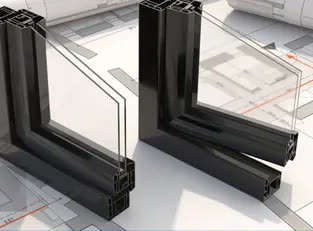
High-performance architectural window systems utilize multi-chambered polyamide thermal barriers (such as Technoform or custom-engineered glass-reinforced nylon strips) inserted between the interior and exterior aluminum profiles. This structure effectively disrupts thermal conduction. Furthermore, the integration of triple-glazed or double-glazed insulated glass units (IGUs) with low-emissivity (Low-E) coatings, argon gas fills, and warm-edge spacers allows modern systems to achieve exceptional thermal efficiency. For projects located in dense urban environments or near transportation hubs, these multi-chambered profiles and specialized acoustic laminates also act as noise dampeners, drastically reducing sound transmission class (STC) ratings to ensure comfortable interior environments.
Q3: What are the manufacturing lead times and scalable production capacities?
Commercial construction schedules are rigid, and any delay in fenestration delivery can stall interior trade work, resulting in severe financial penalties for developers. Consequently, global buyers look closely at a manufacturer's scalable production capacity and delivery reliability.
A dependable manufacturer must operate a highly automated, vertically integrated production facility that covers everything from profile precision cutting and CNC machining to corner crimping and hardware integration. Utilizing advanced automated manufacturing lines allows a supplier to maintain high dimensional accuracy across large-scale orders while minimizing human error. Buyers look for partners with established industrial footprints capable of processing tens of thousands of square meters of glazing annually. This scale ensures that large-scale commercial towers or expansive multi-family residential developments receive their custom orders in structured phases that align perfectly with site installation timelines.
Q4: Can the supplier support custom architectural designs and private label requirements?
No two premium architectural projects are identical. Architects frequently demand custom profile geometries, unique structural configurations, and specific finish options that standard off-the-shelf product catalogs cannot accommodate.
For brands looking to market proprietary fenestration solutions under their own corporate identity, partnering with a competent custom aluminum window private label manufacturer is essential. This arrangement requires an experienced research and development team capable of translating conceptual architectural sketches into functional shop drawings and manufacturing schematics. The supplier must offer a wide range of surface treatments, including architectural-grade PVDF coatings, marine-grade powder coatings compliant with Qualicoat standards, and advanced anodized finishes. These options ensure long-term resistance to UV degradation, salt-spray corrosion, and mechanical wear, while maintaining complete design consistency across custom portfolios.
Q5: What are the Minimum Order Quantity (MOQ) thresholds for commercial projects?
Balancing procurement budgets requires clear understanding of a manufacturer’s volume requirements. Buyers frequently encounter challenges when dealing with factories that enforce rigid, large-scale production limits that do not align with boutique commercial projects or phased real estate developments.
Understanding a professional aluminum window manufacturer MOQ policy is critical during the early budgeting and design phases. Flexible tier-structured manufacturing models allow suppliers to accommodate both high-volume landmark developments and highly customized, lower-volume architectural projects. When a manufacturer optimizes its automated extrusion and assembly setups, it can offer reasonable minimum thresholds without sacrificing cost-efficiencies or increasing unit costs. This structural flexibility allows developers to acquire premium, project-specific window configurations without carrying excess inventory costs.
Q6: How does the supplier guarantee the quality and longevity of integrated hardware components?
An aluminum window system is only as reliable as its moving parts. The operational longevity of casement, tilt-and-turn, sliding, or panoramic windows depends heavily on the architectural hardware integrated into the sash and frame profiles.
Experienced buyers expect suppliers to source heavy-duty hardware systems from globally recognized brands, or utilize proprietary hardware systems that have undergone strict cyclic durability testing. Hinge mechanisms, multi-point locking systems, rollers, and operators must be rated for tens of thousands of open-and-close cycles to prevent sagging, misalignment, and air infiltration over decades of use. Utilizing corrosion-resistant stainless steel (SUS304 or SUS316) and zinc alloy components ensures that the locking mechanisms remain smooth and secure, providing long-term structural safety and structural wind-load resistance.
Q7: What quality control protocols are implemented throughout the production lifecycle?
To prevent costly on-site remediations and structural retrofitting, global buyers require a transparent, traceable, and thoroughly documented quality assurance framework from their manufacturing partners.
A reliable manufacturer must implement a strict multi-stage quality control process that begins with the incoming inspection of raw aluminum billets and glazing units. During the fabrication process, computerized digital calipers and automated optical sensors monitor cross-sectional tolerances, corner joinery alignment, and gasket integration. Following assembly, specialized technicians subject sample units from every production batch to rigorous testing for water penetration, air leakage, and mechanical operational smoothness. Each window assembly should be tagged with a unique barcode or tracking identifier, allowing full manufacturing traceability from the raw material phase through to final onsite installation.
Q8: How are the products packaged and secured to prevent transit damage during ocean freight?
International shipping introduces significant risks, including mechanical vibrations, container humidity fluctuations, salt-air exposure, and rough material handling at global ports. Damaged glazing or scratched aluminum finishes upon arrival can completely disrupt project timelines.
To mitigate these logistical risks, premium suppliers implement heavy-duty, multi-layer export packaging standards. Aluminum profiles are wrapped in protective polyethylene films to eliminate surface scratching, while window frames are enclosed in impact-absorbing foam corner guards. The entire window assembly is then secured within custom-engineered, fumigated wooden crates or steel-reinforced pallets. These crates are tightly packed and braced inside shipping containers using heavy-duty strapping and air bags to prevent shifting during maritime transit. Additionally, desiccant packs are placed within the packaging to manage moisture and prevent oxidation or finish clouding during long ocean voyages.
Q9: What past project portfolio and real-world application examples can the supplier demonstrate?
Theoretical performance metrics and laboratory certificates are critical, but real-world field performance remains the ultimate proof of a manufacturer’s engineering capability. Buyers consistently request comprehensive project portfolios to evaluate a supplier's track record in diverse climates and structural environments.
A reputable fenestration partner can provide a diverse array of global project references, including high-density residential towers, luxury coastal villas, institutional buildings, and commercial offices. Examining a supplier's past work allows procurement teams to analyze how specific configurations—such as minimalist panoramic window systems, structural glass curtain walls, or heavy-duty thermal break casements—perform over time under actual environmental stresses. Suppliers that maintain transparent documentation of their completed projects demonstrate a proven capability to coordinate with international general contractors and deliver complex architectural systems that meet both aesthetic and engineering expectations.
Q10: What level of technical support and after-sales service does the manufacturer provide?
The procurement relationship does not end once the shipping containers leave the factory dock. Complex window systems require deep technical expertise during the installation, caulking, and final commissioning phases.
Global buyers look for manufacturers that provide dedicated engineering support, including comprehensive shop drawings, anchoring details, and step-by-step installation manuals tailored to specific building substrates. If structural adjustments are required on-site, having access to prompt digital technical consultations or on-site supervisory services is invaluable. Furthermore, a clear, transparent warranty structure covering aluminum extrusions, surface finishes, insulated glass units, and hardware components provides long-term peace of mind to developers and property owners alike, confirming the manufacturer's long-term commitment to their product's performance.
The DERCHI Advantage: Engineering Excellence for the Global Market
To ensure complete peace of mind, every product undergoes rigorous multi-stage quality control checks and is packed using heavy-duty export framing systems to guarantee damage-free arrival. With a proven track record of successful installations worldwide, DERCHI combines technical expertise, reliable manufacturing capacity, and structured after-sales support to serve as a trusted long-term partner for global buyers, developers, and architects.
For more information regarding product specifications, past project applications, and custom manufacturing capabilities, please visit the official company platform at https://www.dejiypwindow.com/.
To streamline this selection process and mitigate supply chain risks, international procurement teams typically subject potential manufacturing partners to a comprehensive vetting protocol. This systematic review covers raw material sourcing, engineering capabilities, quality control compliance, and global logistical infrastructure. In this comprehensive guide, we address the top ten critical questions global buyers ask before finalizing an architectural window contract, providing detailed, technically accurate answers from the operational perspective of DERCHI Doors and Windows.
Q1: How does the manufacturer ensure structural integrity and compliance with international building codes?
The foundational criterion for selecting any fenestration partner is their ability to engineering products that withstand localized wind loads, seismic activities, and structural deflections. Global buyers must verify that a supplier’s engineering department uses advanced finite element analysis (FEA) to simulate structural stresses before production begins.
A qualified OEM aluminum window supplier must demonstrate that its product profiles are extruded from high-grade aluminum alloys, such as 6063-T5 or 6063-T6, which provide the optimal balance of tensile strength and machining precision. Compliance with global standards—such as North American NAFS (AAMA/WDMA/CSA), European CE marking (EN 14351-1), and Australian AS2047—is non-negotiable. Leading manufacturers maintain rigorous in-house testing laboratories equipped to perform continuous positive and negative wind pressure tests, ensuring that every architectural window system installed in coastal or high-rise environments performs reliably under extreme environmental pressures.
Q2: What thermal and acoustic insulation technologies are integrated into the window systems?
As global sustainability mandates like LEED, Passive House, and BREEAM become standard across commercial real estate, the thermal performance of aluminum windows is under intense scrutiny. Standard aluminum conducts heat rapidly; therefore, professional buyers require advanced thermal break technology to meet strict U-value targets.
High-performance architectural window systems utilize multi-chambered polyamide thermal barriers (such as Technoform or custom-engineered glass-reinforced nylon strips) inserted between the interior and exterior aluminum profiles. This structure effectively disrupts thermal conduction. Furthermore, the integration of triple-glazed or double-glazed insulated glass units (IGUs) with low-emissivity (Low-E) coatings, argon gas fills, and warm-edge spacers allows modern systems to achieve exceptional thermal efficiency. For projects located in dense urban environments or near transportation hubs, these multi-chambered profiles and specialized acoustic laminates also act as noise dampeners, drastically reducing sound transmission class (STC) ratings to ensure comfortable interior environments.
Q3: What are the manufacturing lead times and scalable production capacities?
Commercial construction schedules are rigid, and any delay in fenestration delivery can stall interior trade work, resulting in severe financial penalties for developers. Consequently, global buyers look closely at a manufacturer's scalable production capacity and delivery reliability.
A dependable manufacturer must operate a highly automated, vertically integrated production facility that covers everything from profile precision cutting and CNC machining to corner crimping and hardware integration. Utilizing advanced automated manufacturing lines allows a supplier to maintain high dimensional accuracy across large-scale orders while minimizing human error. Buyers look for partners with established industrial footprints capable of processing tens of thousands of square meters of glazing annually. This scale ensures that large-scale commercial towers or expansive multi-family residential developments receive their custom orders in structured phases that align perfectly with site installation timelines.
Q4: Can the supplier support custom architectural designs and private label requirements?
No two premium architectural projects are identical. Architects frequently demand custom profile geometries, unique structural configurations, and specific finish options that standard off-the-shelf product catalogs cannot accommodate.
For brands looking to market proprietary fenestration solutions under their own corporate identity, partnering with a competent custom aluminum window private label manufacturer is essential. This arrangement requires an experienced research and development team capable of translating conceptual architectural sketches into functional shop drawings and manufacturing schematics. The supplier must offer a wide range of surface treatments, including architectural-grade PVDF coatings, marine-grade powder coatings compliant with Qualicoat standards, and advanced anodized finishes. These options ensure long-term resistance to UV degradation, salt-spray corrosion, and mechanical wear, while maintaining complete design consistency across custom portfolios.
Q5: What are the Minimum Order Quantity (MOQ) thresholds for commercial projects?
Balancing procurement budgets requires clear understanding of a manufacturer’s volume requirements. Buyers frequently encounter challenges when dealing with factories that enforce rigid, large-scale production limits that do not align with boutique commercial projects or phased real estate developments.
Understanding a professional aluminum window manufacturer MOQ policy is critical during the early budgeting and design phases. Flexible tier-structured manufacturing models allow suppliers to accommodate both high-volume landmark developments and highly customized, lower-volume architectural projects. When a manufacturer optimizes its automated extrusion and assembly setups, it can offer reasonable minimum thresholds without sacrificing cost-efficiencies or increasing unit costs. This structural flexibility allows developers to acquire premium, project-specific window configurations without carrying excess inventory costs.
Q6: How does the supplier guarantee the quality and longevity of integrated hardware components?
An aluminum window system is only as reliable as its moving parts. The operational longevity of casement, tilt-and-turn, sliding, or panoramic windows depends heavily on the architectural hardware integrated into the sash and frame profiles.
Experienced buyers expect suppliers to source heavy-duty hardware systems from globally recognized brands, or utilize proprietary hardware systems that have undergone strict cyclic durability testing. Hinge mechanisms, multi-point locking systems, rollers, and operators must be rated for tens of thousands of open-and-close cycles to prevent sagging, misalignment, and air infiltration over decades of use. Utilizing corrosion-resistant stainless steel (SUS304 or SUS316) and zinc alloy components ensures that the locking mechanisms remain smooth and secure, providing long-term structural safety and structural wind-load resistance.
Q7: What quality control protocols are implemented throughout the production lifecycle?
To prevent costly on-site remediations and structural retrofitting, global buyers require a transparent, traceable, and thoroughly documented quality assurance framework from their manufacturing partners.
A reliable manufacturer must implement a strict multi-stage quality control process that begins with the incoming inspection of raw aluminum billets and glazing units. During the fabrication process, computerized digital calipers and automated optical sensors monitor cross-sectional tolerances, corner joinery alignment, and gasket integration. Following assembly, specialized technicians subject sample units from every production batch to rigorous testing for water penetration, air leakage, and mechanical operational smoothness. Each window assembly should be tagged with a unique barcode or tracking identifier, allowing full manufacturing traceability from the raw material phase through to final onsite installation.
Q8: How are the products packaged and secured to prevent transit damage during ocean freight?
International shipping introduces significant risks, including mechanical vibrations, container humidity fluctuations, salt-air exposure, and rough material handling at global ports. Damaged glazing or scratched aluminum finishes upon arrival can completely disrupt project timelines.
To mitigate these logistical risks, premium suppliers implement heavy-duty, multi-layer export packaging standards. Aluminum profiles are wrapped in protective polyethylene films to eliminate surface scratching, while window frames are enclosed in impact-absorbing foam corner guards. The entire window assembly is then secured within custom-engineered, fumigated wooden crates or steel-reinforced pallets. These crates are tightly packed and braced inside shipping containers using heavy-duty strapping and air bags to prevent shifting during maritime transit. Additionally, desiccant packs are placed within the packaging to manage moisture and prevent oxidation or finish clouding during long ocean voyages.
Q9: What past project portfolio and real-world application examples can the supplier demonstrate?
Theoretical performance metrics and laboratory certificates are critical, but real-world field performance remains the ultimate proof of a manufacturer’s engineering capability. Buyers consistently request comprehensive project portfolios to evaluate a supplier's track record in diverse climates and structural environments.
A reputable fenestration partner can provide a diverse array of global project references, including high-density residential towers, luxury coastal villas, institutional buildings, and commercial offices. Examining a supplier's past work allows procurement teams to analyze how specific configurations—such as minimalist panoramic window systems, structural glass curtain walls, or heavy-duty thermal break casements—perform over time under actual environmental stresses. Suppliers that maintain transparent documentation of their completed projects demonstrate a proven capability to coordinate with international general contractors and deliver complex architectural systems that meet both aesthetic and engineering expectations.
Q10: What level of technical support and after-sales service does the manufacturer provide?
The procurement relationship does not end once the shipping containers leave the factory dock. Complex window systems require deep technical expertise during the installation, caulking, and final commissioning phases.
Global buyers look for manufacturers that provide dedicated engineering support, including comprehensive shop drawings, anchoring details, and step-by-step installation manuals tailored to specific building substrates. If structural adjustments are required on-site, having access to prompt digital technical consultations or on-site supervisory services is invaluable. Furthermore, a clear, transparent warranty structure covering aluminum extrusions, surface finishes, insulated glass units, and hardware components provides long-term peace of mind to developers and property owners alike, confirming the manufacturer's long-term commitment to their product's performance.
The DERCHI Advantage: Engineering Excellence for the Global Market
To ensure complete peace of mind, every product undergoes rigorous multi-stage quality control checks and is packed using heavy-duty export framing systems to guarantee damage-free arrival. With a proven track record of successful installations worldwide, DERCHI combines technical expertise, reliable manufacturing capacity, and structured after-sales support to serve as a trusted long-term partner for global buyers, developers, and architects.
For more information regarding product specifications, past project applications, and custom manufacturing capabilities, please visit the official company platform at https://www.dejiypwindow.com/.
DERCHI
DERCHI
Legal Disclaimer:
EIN Presswire provides this news content "as is" without warranty of any kind. We do not accept any responsibility or liability for the accuracy, content, images, videos, licenses, completeness, legality, or reliability of the information contained in this article. If you have any complaints or copyright issues related to this article, kindly contact the author above.