VANCOUVER, British Columbia, May 19, 2026 (GLOBE NEWSWIRE) -- Orezone Gold Corporation (TSX: ORE | ASX: ORE | OTCQX: ORZCF) (the “Company” or “Orezone”) is pleased to announce the first set of drill results from its recently acquired Casa Berardi gold mine, located in Quebec, Canada.
Selected Drill Highlights1:
-
6.47g/t over 21.5m (CBF-160-233)
|
-
7.20g/t over 14.9m (CBF-134-125)
|
Incl. 8.94g/t over 12.7m
|
Incl. 16.18g/t over 3.4m
|
-
4.35g/t over 19.5m (CBF-160-233)
|
-
16.10g/t over 6.7m (CBF-160-230)
|
Incl. 5.86g/t over 6.4m
|
-
5.51g/t over 18.0m (CBF-160-232)
|
Incl. 5.72g/t over 5.5m
|
Incl. 9.33g/t over 3.5m
|
-
6.92g/t over 7.5m (CBF-134-127)
|
-
11.97g/t over 3.5m (CBF-134-135)
|
Patrick Downey, President and CEO, commented “We are extremely pleased to release this first set of drill results from Casa Berardi, which clearly demonstrates the mine’s significant and untapped exploration upside. The results are from the near-surface F160 and F134 zones, and serve to support planned pit expansions, and more importantly, further illustrate the down-plunge continuity of high-grade mineralization in each zone. Taken together with historical drill results, these plunging zones of mineralization represent potential future underground mining centers, which are located proximal to existing underground infrastructure.
In addition to ramping-up underground exploration drilling at Casa Berardi, surface drilling of the F160 and F134 zones will remain ongoing. The delineation of F160 Zone at depth is expected to further supplement the Company’s plans to increase underground mining rates by reopening the East Mine, while future step-out drilling down plunge of the F134 Zone has the potential to open a significant new exploration front in the Gap Zone.
Overall, we are incredibly encouraged by these initial drill results at Casa Berardi, and look forward to providing regular exploration updates as we incrementally ramp-up exploration to a sustained 80,000-100,000m/yr.”
F160 Zone
The F160 Zone hosts the operating F160 pit, which is located adjacent to the Casa Berardi process plant. Mineralization is open outside of the current F160 life-of-mine pit, with mineralized lenses plunging both to the east and west at 30-40 degrees. Ongoing drilling within the F160 Zone remains focused on testing the down-plunge continuity of high-grade mineralization, with trade-off studies underway to evaluate an expanded F160 pit and a future transition to underground mining.
Initial 2026 drilling of the F160 Zone returned several significant intercepts, including1:
|
6.47g/t over 21.5m (CBF-160-233) |
16.10g/t over 6.7m (CBF-160-230) |
|
5.51g/t over 18.0m (CBF-160-232) |
4.35g/t over 19.5m (CBF-160-233) |
|
5.40g/t over 5.4m (CBF-148-086) |
6.17g/t over 4.2m (CBF-148-086) |
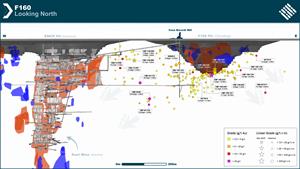
Furthermore, as detailed in Figure 2, several notable historical results support the broader continuity of mineralization at depth, which include1:
|
104.82g/t Au over 4.9m (CBE-0049) |
33.55g/t Au over 3.9m (CBF-04-115) |
|
25.80g/t Au over 3.0m (CBF-04-122) |
8.62g/t Au over 14.7m (86882-0) |
|
10.47g/t Au over 7.3m (CBS-13-558) |
6.21g/t Au over 17.2m (84703-0) |
|
5.17g/t Au over 26.5m (CBF-160-101) |
5.03g/t Au over 24.2m (CBF-160-136) |
|
13.08g/t Au over 4.0m (CBS-13-551) |
12.04g/t Au over 3.5m (CBF-160-152) |
|
10.79g/t Au over 4.7m (CBS-20-011) |
12.05g/t Au over 3.4m (84753-0) |
F134 Zone
The F134 Zone comprises multiple near-surface lenses of mineralization, plunging to the east at 40-50 degrees. The zone hosts the undeveloped F134 pit, with distal mineralization traced a further 750m down plunge below the current designed pit limits. Ongoing drilling within the F134 Zone remains focused on 1) infill drilling to support an expansion of the F134 pit, and 2) down plunge infill and step-out drilling targeting high-grade veins in support of future underground mining. As drilling continues to ramp-up at Casa Berardi, one of the priority targets moving forward will be the broader delineation of mineralization down plunge of the F134 Zone into the Gap Zone, which has seen limited drilling to date.
Initial 2026 drilling of the F134 Zone returned several significant intercepts, including1:
|
7.20g/t over 14.9m (CBF-134-125) |
6.92g/t over 7.5m (CBF-134-127) |
|
11.97g/t over 3.5m (CBF-134-135) |
5.94g/t over 3.0m (CBF-134-116) |
|
2.43g/t over 6.1m (CBF-134-136) |
4.52g/t over 2.6m (CBF-134-134) |
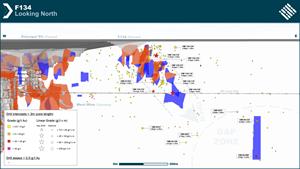
As detailed in Figure 3, there are several notable historical results which illustrate the broader continuity of mineralization at depth including1:
|
8.63g/t Au over 4.9m (CBS-21-043) |
9.95g/t Au over 4.5m (CBS-04-098) |
|
5.86g/t Au over 4.5m (CBP-0414) |
6.20g/t Au over 3.5m (CBS-04-123) |
|
5.00g/t Au over 3.8m (CBE-0037) |
4.73g/t Au over 3.0m (CBP-0507) |
Casa Berardi Exploration Outlook
Exploration drilling at Casa Berardi has recently been reinitiated, with four exploration rigs now turning and a fifth to be added in early June. The Company plans to complete 40,000-60,000m of exploration drilling this year at Casa Berardi, with plans to systematically ramp up to a sustainable 80,000-100,000m/yr moving forward.
The 2026 exploration program commenced with surface drilling at the F160 and F134 zones, with ongoing drilling targeting down-plunge extensions at each zone. These near-surface zones, which are proximal to existing underground infrastructure, represent significant and actionable exploration targets, and have the potential to materially expand the current underground resource (M&I: 4.89Mt at 5.93g/t Au containing 934,000oz, Inferred: 1.91Mt at 7.02g/t Au containing 432,000oz).2
More recently, underground drilling has commenced in the 118N Zone (~800m depth from surface) as a follow-up to several significant historical intercepts on the north side of the Casa Berardi fault. Given that the vast majority of underground mineralization identified to date at Casa Berardi is located on the south side of the fault, this exploration upside to the north has significant potential implications in-terms of future resource and production growth moving forward. We see supporting evidence for this thesis in the open pits, where mineralization along secondary and tertiary structures to the north of the Casa Berardi fault has locally been traced beneath the pits to depth of ~350m from surface.
Selected 118N Zone historical intercepts:
269.78g/t Au over 1.0m (CBP-1440)
14.34g/t Au over 2.6m (CBW-1018)
11.53g/t Au over 3.0m (CBW-1440)
|
As exploration drilling continues to ramp-up at Casa Berardi, future targets include the down-plunge delineation of the well-established WMCP and Principal ore shoots at depth. In support of this drilling, the Company has mobilized an underground mining contractor to site, which in addition to increasing mine development rates, will be utilized to establish the requisite drill stations for this targeting.
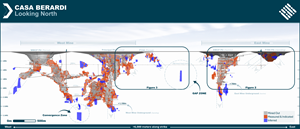
Figure 1 – Casa Berardi Long Section (Looking North)
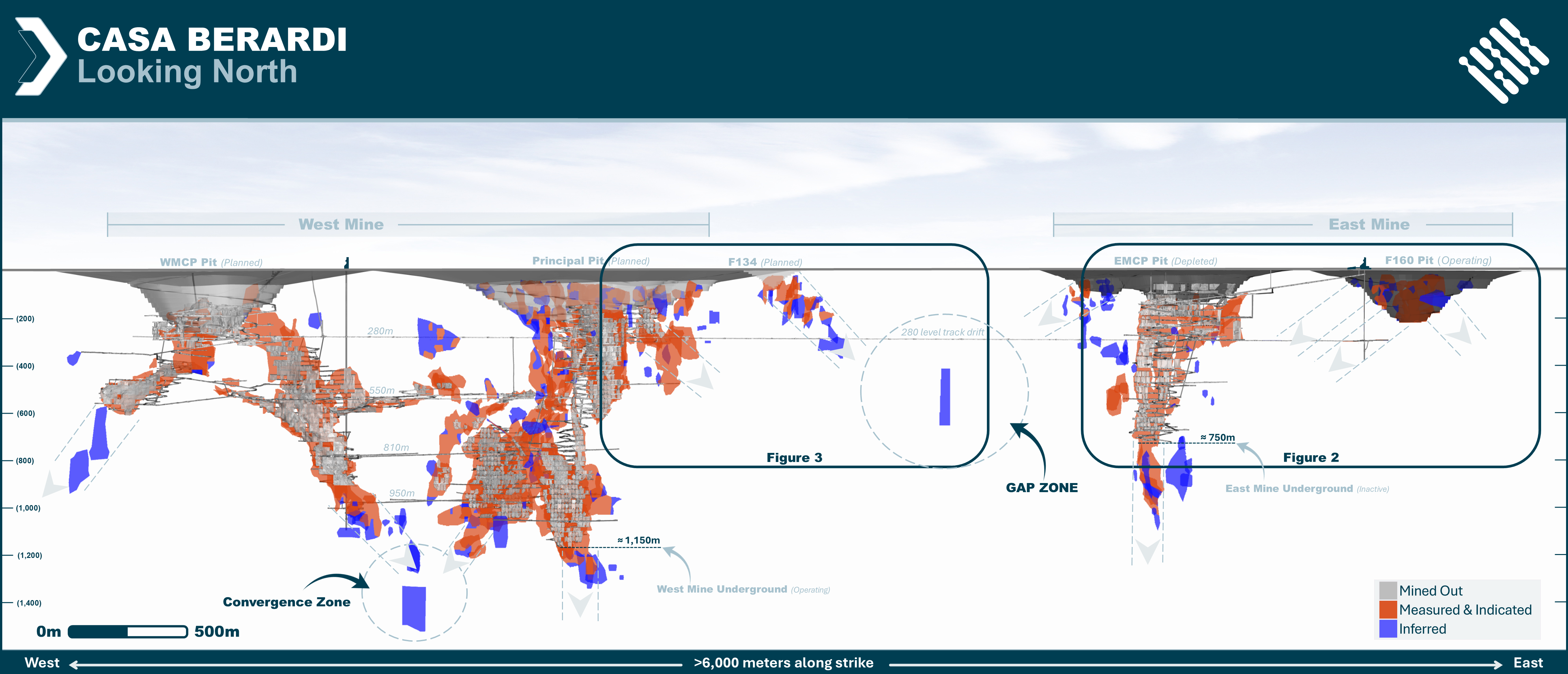
Figure 2 – F160 (Looking North)
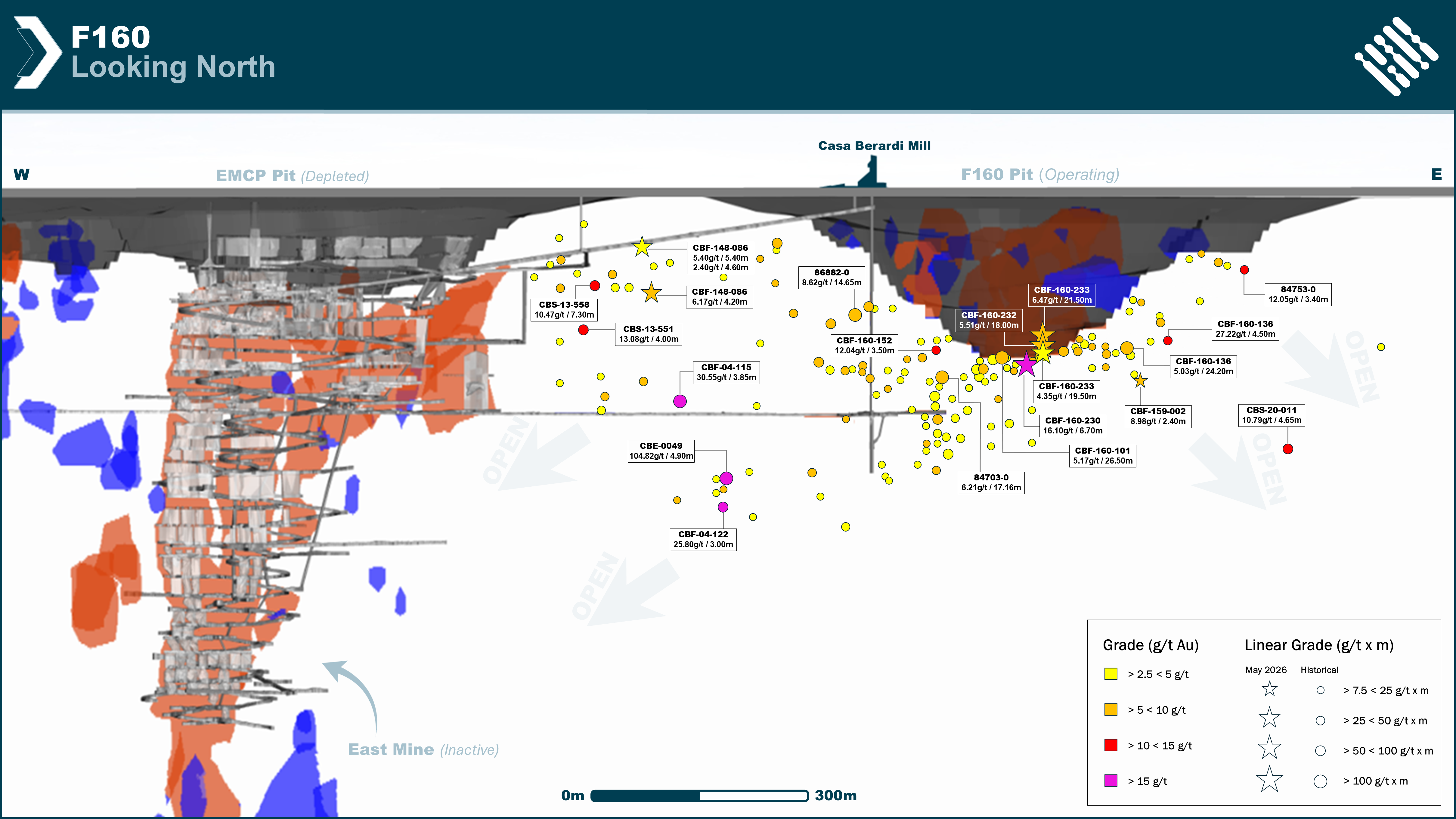
Figure 3 – F134 (Looking North)
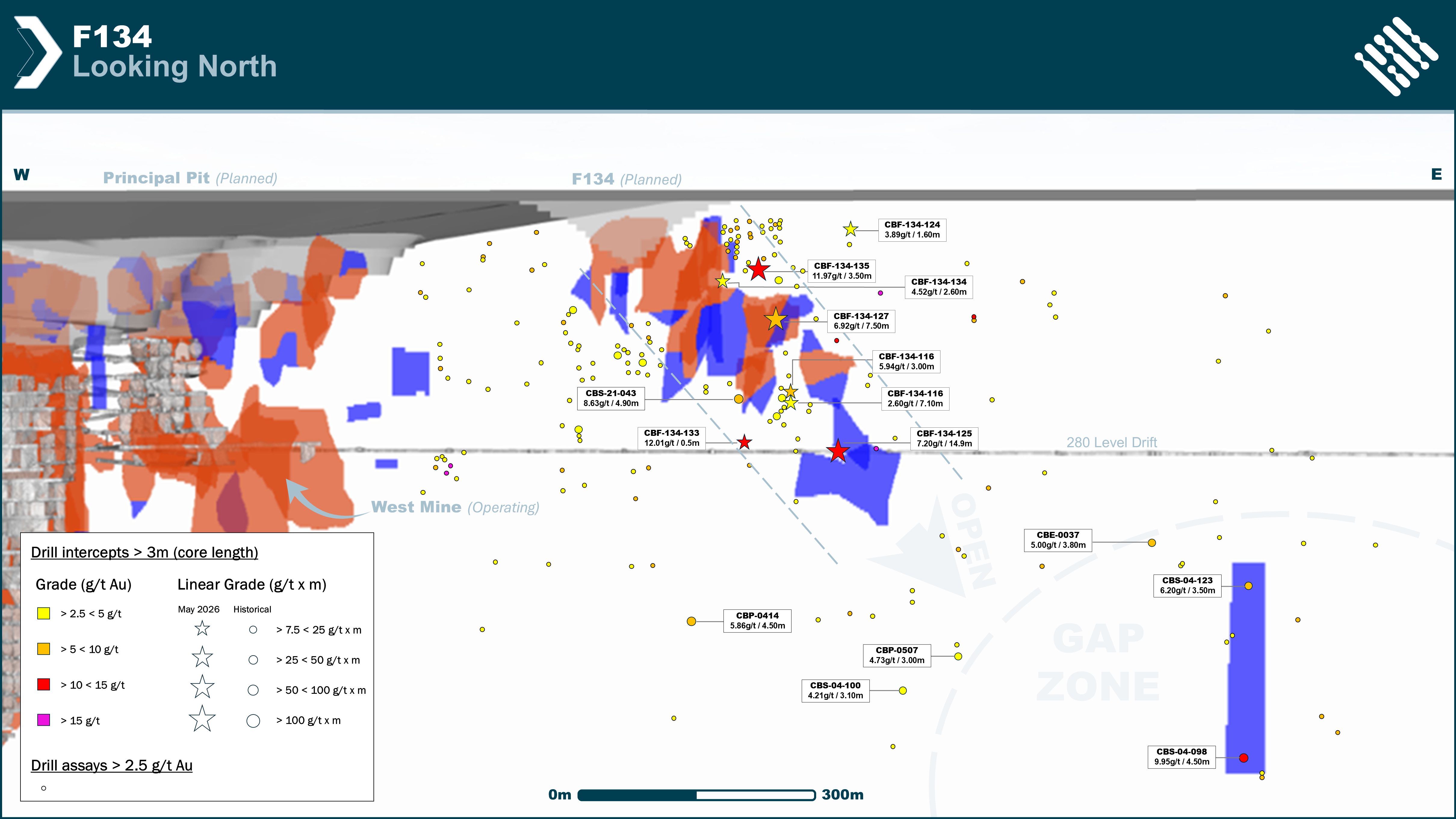
Table 1 – Drill Results Table
| Hole |
Zone |
Easting
(m) |
Northing
(m) |
Elv.
(m) |
Dip
(deg.) |
Azi.
(deg.) |
EOH
(m) |
From
(m) |
To
(m) |
Length*
(m) |
Grade
(g/t Au) |
| CBF-134-116 |
134 |
625504 |
5492105 |
284 |
-62 |
360 |
297 |
257.0 |
260.0 |
3.0 |
5.94 |
| Incl. |
|
|
|
|
|
|
|
257.0 |
258.0 |
1.0 |
14.00 |
| And |
|
|
|
|
|
|
|
266.8 |
269.0 |
2.2 |
3.12 |
| And |
|
|
|
|
|
|
|
273.0 |
280.1 |
7.1 |
2.60 |
| Incl. |
|
|
|
|
|
|
|
274.0 |
275.4 |
1.4 |
6.41 |
| CBF-134-124 |
134 |
625576 |
5492203 |
284 |
-46 |
360 |
135 |
45.5 |
47.1 |
1.6 |
3.89 |
| And |
|
|
|
|
|
|
|
64.5 |
67.0 |
2.5 |
2.22 |
| CBF-134-125 |
134 |
625580 |
5492088 |
284 |
-63 |
356 |
372 |
315.0 |
329.9 |
14.9 |
7.20 |
| Incl. |
|
|
|
|
|
|
|
318.6 |
322.0 |
3.4 |
16.18 |
| Incl. |
|
|
|
|
|
|
|
323.0 |
326.2 |
3.2 |
8.93 |
| CBF-134-127 |
134 |
625495 |
5492103 |
284 |
-58 |
356 |
277.5 |
170.0 |
177.5 |
7.5 |
6.92 |
| Incl. |
|
|
|
|
|
|
|
172.0 |
172.8 |
0.8 |
38.02 |
| CBF-134-131 |
134 |
625085 |
5492195 |
284 |
-49 |
9 |
126 |
121.0 |
122.0 |
1.0 |
9.05 |
| CBF-134-132 |
134 |
625148 |
5492295 |
284 |
-46 |
351 |
147 |
|
|
|
NSR |
| CBF-134-133 |
134 |
625461 |
5492039 |
284 |
-61 |
360 |
354 |
332.0 |
332.5 |
0.5 |
12.01 |
| CBF-134-134 |
134 |
625426 |
5492144 |
284 |
-61 |
360 |
209 |
81.0 |
82.2 |
1.2 |
3.31 |
| And |
|
|
|
|
|
|
|
94.1 |
97.5 |
3.4 |
2.57 |
| Incl. |
|
|
|
|
|
|
|
94.1 |
94.9 |
0.8 |
7.20 |
| And |
|
|
|
|
|
|
|
115.5 |
118.1 |
2.6 |
4.52 |
| And |
|
|
|
|
|
|
|
135.6 |
140.0 |
4.4 |
2.29 |
| CBF-134-135 |
134 |
625470 |
5492146 |
284 |
-51 |
2 |
162 |
99.5 |
103.0 |
3.5 |
11.97 |
| Incl. |
|
|
|
|
|
|
|
100.2 |
101.8 |
1.6 |
22.99 |
| CBF-134-136 |
134 |
625344 |
5492105 |
284 |
-59 |
360 |
198 |
106.0 |
112.1 |
6.1 |
2.43 |
| CBF-148-086 |
148 |
627476 |
5492601 |
284 |
-45 |
7 |
225 |
90.0 |
95.4 |
5.4 |
5.40 |
| Incl. |
|
|
|
|
|
|
|
93.5 |
94.9 |
1.4 |
9.91 |
| And |
|
|
|
|
|
|
|
98.1 |
100.5 |
2.4 |
4.60 |
| And |
|
|
|
|
|
|
|
186.9 |
191.1 |
4.2 |
6.17 |
| Incl. |
|
|
|
|
|
|
|
186.9 |
188.5 |
1.6 |
12.01 |
| CBF-159-002 |
160 |
628146 |
5492639 |
284 |
-49 |
358 |
414 |
362.3 |
364.7 |
2.4 |
8.98 |
| And |
|
|
|
|
|
|
|
374.5 |
376.1 |
1.6 |
2.96 |
| CBF-160-230 |
160 |
627974 |
5492976 |
124 |
-45 |
7 |
120 |
51.0 |
56.2 |
5.2 |
4.18 |
| And |
|
|
|
|
|
|
|
62.0 |
68.0 |
6.0 |
2.94 |
| Incl. |
|
|
|
|
|
|
|
62.0 |
63.0 |
1.0 |
9.87 |
| And |
|
|
|
|
|
|
|
84.8 |
91.5 |
6.7 |
16.10 |
| Incl. |
|
|
|
|
|
|
|
88.5 |
90.3 |
1.8 |
45.84 |
| And |
|
|
|
|
|
|
|
103.0 |
106.0 |
3.0 |
2.84 |
| CBF-160-232 |
160 |
627998 |
5492977 |
124 |
-55 |
5 |
120 |
3.6 |
11.3 |
7.7 |
3.38 |
| And |
|
|
|
|
|
|
|
16.4 |
18.0 |
1.6 |
4.03 |
| And |
|
|
|
|
|
|
|
21.6 |
30.0 |
8.4 |
2.75 |
| Incl. |
|
|
|
|
|
|
|
23.4 |
27.0 |
3.6 |
4.46 |
| And |
|
|
|
|
|
|
|
38.0 |
56.0 |
18.0 |
5.51 |
| Incl. |
|
|
|
|
|
|
|
42.0 |
44.5 |
2.5 |
8.82 |
| Incl. |
|
|
|
|
|
|
|
50.0 |
53.5 |
3.5 |
9.33 |
| And |
|
|
|
|
|
|
|
62.3 |
63.5 |
1.2 |
2.94 |
| CBF-160-233 |
160 |
627998 |
5492977 |
124 |
-65 |
9 |
111 |
3.0 |
4.0 |
1.0 |
21.12 |
| And |
|
|
|
|
|
|
|
12.0 |
33.5 |
21.5 |
6.47 |
| Incl. |
|
|
|
|
|
|
|
17.3 |
30.0 |
12.7 |
8.94 |
| And |
|
|
|
|
|
|
|
43.0 |
62.5 |
19.5 |
4.35 |
| Incl. |
|
|
|
|
|
|
|
49.6 |
56.0 |
6.4 |
5.86 |
| Incl. |
|
|
|
|
|
|
|
57.0 |
62.5 |
5.5 |
5.72 |
ABOUT OREZONE GOLD CORPORATION
Orezone Gold is an emerging intermediate gold producer with operations in Canada and West Africa. Its Casa Berardi and Bomboré gold mines host significant mineral endowments, growth opportunities, and exploration upside. The recently acquired Casa Berardi mine in Quebec has produced over 3.2Moz of gold to date while the Bomboré mine was constructed and brought into production by Orezone in late 2022.
Orezone is led by an experienced management team committed to safe, sustainable, and responsible mining practices, with a focus on delivering long-term value for all stakeholders.
CONTACT INFORMATION
Patrick Downey
President and Chief Executive Officer
Amanda Mallough
Vice President, Investor Relations
Tel: 1 778 945 8977
info@orezone.com / www.orezone.com
For further information please contact Orezone at +1 (778) 945-8977 or visit the Company’s website at www.orezone.com.
The Toronto Stock Exchange neither approves nor disapproves the information contained in this news release.
This announcement was authorized for release by Patrick Downey, Director, President & CEO.
Qualified Persons
Mr. Alexandre Nickerson, P. Eng., Geology Superintendent of Orezone Quebec Inc. has reviewed and approved the scientific and technical information contained in this press release. Mr. Nickerson is a “Qualified” Person” under NI 43-101 and is not independent of Orezone within the meaning of NI 43-101. To the best of Mr. Nickerson’s knowledge, information, and belief, there is no new material scientific or technical information that would make this disclosure inaccurate or misleading.
Competent Persons
In accordance with ASX Listing Rule 5.12, the information in this announcement relating to the Casa Berardi Mine is confirmed as an accurate representation of the available data for the project by Alexandre Nickerson, P.Eng, an employee of Orezone Quebec Inc., is a member of the Ordre des ingénieurs du Québec and has sufficient experience that is relevant to the style of mineralisation and type of deposit under consideration, and to the activity being undertaken to qualify as a Competent Person, as defined in the JORC Code. Mr. Nickerson has over 7 years’ experience and is a full-time employee as Geology Superintendent for Orezone Quebec Inc. Mr. Nickerson consents to the inclusion in this announcement of the matters based on this information in the form and context in which they appear.
Cautionary Note Regarding Forward-Looking Statements
This press release contains certain information that may constitute “forward-looking information” within the meaning of applicable Canadian Securities laws and “forward-looking statements” within the meaning of applicable U.S. securities laws (together, “forward-looking statements”). Forward-looking statements are frequently characterized by words such as “plan”, “expect”, “project”, “intend”, “believe”, “anticipate”, “estimate”, “potential”, “possible” and other similar words, or statements that certain events or conditions “may”, “will”, “could”, or “should” occur. Forward-looking statements in this press release include, but are not limited to, statements regarding the exploration potential at Casa Berardi; the continuity, extent and potential expansion of mineralization; the potential for future underground mining centers and pit expansions; the potential to increase underground mining rates; the timing, scope and results of current and future drilling programs; the delineation of additional mineral resources; the potential development of new exploration fronts; and the Company’s planned exploration activities and expenditures at Casa Berardi.
All such forward-looking statements are based on certain assumptions and analyses made by management in light of their experience and perception of historical trends, current conditions and expected future developments, as well as other factors management and the qualified persons believe are appropriate in the circumstances.
All forward-looking statements are subject to a variety of risks and uncertainties and other factors that could cause actual events or results to differ materially from those projected in the forward-looking statements including, but not limited to, delays caused by pandemics, terrorist or other violent attacks (including cyber security attacks), the failure of parties to contracts to honour contractual commitments, unexpected changes in laws, rules or regulations, or their enforcement by applicable authorities; social or labour unrest; changes in commodity prices; unexpected failure or inadequacy of infrastructure, the possibility of unanticipated costs and expenses, accidents and equipment breakdowns, political risk, unanticipated changes in key management personnel and general economic, market or business conditions, the failure of exploration programs, including drilling programs, to deliver anticipated results and the failure of ongoing and uncertainties relating to the availability and costs of financing needed in the future, and other factors described in the Company's most recent annual information form, management discussion and analysis filed on SEDAR+. Readers are cautioned not to place undue reliance on forward-looking statements.
Although the forward-looking statements contained in this press release are based upon what management of the Company believes are reasonable assumptions, the Company cannot assure investors that actual results will be consistent with these forward-looking statements. These forward-looking statements are made as of the date of this press release and are expressly qualified in their entirety by this cautionary statement. Subject to applicable securities laws, the Company does not assume any obligation to update or revise the forward-looking statements contained herein to reflect events or circumstances occurring after the date of this press release.
JORC Code, 2012 Edition
All dollar amounts are in USD unless otherwise indicated
Section 1 – Sampling Techniques and Data
| Criteria |
JORC Code Explanation |
Commentary |
| Sampling techniques |
- Nature and quality of sampling (e.g. cut channels, random chips, or specific specialised industry standard measurement tools appropriate to the minerals under investigation, such as down hole gamma sondes, or handheld XRF instruments, etc.). These examples should not be taken as limiting the broad meaning of sampling.
- Include reference to measures taken to ensure sample representivity and the appropriate calibration of any measurement tools or systems used.
- Aspects of the determination of mineralisation that are Material to the Public Report.
- In cases where ‘industry standard’ work has been done this would be relatively simple (e.g. ‘reverse circulation drilling was used to obtain 1 m samples from which 3 kg was pulverised to produce a 30 g charge for fire assay’). In other cases, more explanation may be required, such as where there is coarse gold that has inherent sampling problems. Unusual commodities or mineralisation types (e.g. submarine nodules) may warrant disclosure of detailed information.
|
- Pre-production drilling NQ drill core samples are collected from whole core samples at a minimum interval of 0.5m and a maximum of 1.0m. Samples are numbered and bagged before dispatch to the mine laboratory.
- Definition drilling NQ drill core samples are collected from half drill core cut evenly lengthwise with a diamond saw at a minimum interval of 0.5m and a maximum of 1.0m. Samples are numbered and bagged before dispatch to the mine laboratory. Remaining half core is kept on site as control sample.
- Exploration drilling NQ drill core samples are collected from half drill core cut evenly lengthwise with a diamond saw at a minimum interval of 0.5m and a maximum of 1.0m. Samples are numbered and bagged before dispatch by truck to the external lab Swastika Laboratory in Timmins, Ontario. Remaining half core is kept on site as control sample.
- Mine laboratory samples is split and submitted for assaying using a conventional fire assay procedure on 15 g sub-sample. Remaining sample pulps is kept for a limited time depending on the drilling purpose.
- Swastika laboratory samples is split and submitted for assaying using a conventional fire assay procedure on 50 g sub-sample.
|
| Drilling techniques |
- Drill type (e.g. core, reverse circulation, open-hole hammer, rotary air blast, auger, Bangka, sonic, etc.) and details (e.g. core diameter, triple or standard tube, depth of diamond tails, face-sampling bit or other type, whether core is oriented and if so, by what method, etc.).
|
- The Mineral Resource estimate includes a total of drill 17,271 diamond drill core holes. Core drilling is the unique drilling technique used to explore, define and delineate mineralized zones. Most drilling used NQ core barrel and sometime HQ and BQ for deeper holes or to telescope through the Casa Berardi fault.
- Core is oriented via a downhole survey of the boreholes using Reflex Instruments EZ-TRAC and Gyroscope. Downhole surveys were completed on all holes at intervals of 3m. All data is validated by the mine professional geologist.
|
| Drill sample recovery |
- Method of recording and assessing core and chip sample recoveries and results assessed.
- Measures taken to maximise sample recovery and ensure representative nature of the samples.
- Whether a relationship exists between sample recovery and grade and whether sample bias may have occurred due to preferential loss/gain of fine/coarse material.
|
- Recovery from core holes is nearly 100%, the Casa Berardi fault being most of the time where core recovery is difficult.
- There is no relationship between sample recovery and grade.
|
| Logging |
- Whether core and chip samples have been geologically and geotechnically logged to a level of detail to support appropriate Mineral Resource estimation, mining studies and metallurgical studies.
- Whether logging is qualitative or quantitative in nature. Core (or costean, channel, etc.) photography.
- The total length and percentage of the relevant intersections logged.
|
- Logging protocols were followed to a level of detail suitable for support of the Mineral Resource and Ore Reserve estimate. Core sample logging included qualitative data such as lithology, alteration, mineralization, competence (RQD) and discontinuities. All core is photographed.
|
| Sub-sampling techniques and sample preparation |
- If core, whether cut or sawn and whether quarter, half or all core taken.
- If non-core, whether riffled, tube sampled, rotary split, etc. and whether sampled wet or dry.
- For all sample types, the nature, quality and appropriateness of the sample preparation technique.
- Quality control procedures adopted for all sub-sampling stages to maximise representivity of samples.
- Measures taken to ensure that the sampling is representative of the in-situ material collected, including for instance results for field duplicate/second-half sampling.
- Whether sample sizes are appropriate to the grain size of the material being sampled.
|
- Core samples are collected from whole (Pre-production drilling) and half-drill core (Definition and Exploration Drilling) cut lengthwise with a diamond saw.
- All whole core samples sent to the mine laboratory, which weigh approximately 10kg each, are entirely crushed to 80% passing (P80) 6.3mm in a jaw crusher. Approximately 200g to 250g of split material is crushed to a 95% minus 150-mesh or 85% minus 200-mesh sample pulp using a ring-and-puck pulverizer. The pulp is laid down on a rubber mat and homogenized. A 15g sub-sample is then collected, weighed, and analyzed by fire assay with an atomic absorption spectrometer (AAS) finish. All results, reported in grams per tonne, are sent electronically to the mine geology department.
- Samples sent to Swastika Laboratory are dried in an oven at 80°C and then are entirely crushed to P80 1.7mm with a jaw crusher and split with a rotary splitter. Approximately one kilogram of the jaw-crushed sample is entirely pulverized to 90% minus 107μm in a ring-and-puck pulverizer. All pulverized material is placed on a rubber mat, homogenized, and transferred into disposable brown paper bags for weighing. A 30g aliquot of pulverized material is split out and analyzed by fire assay with an AAS finish. A second fire assay analysis is completed with a gravimetric finish for samples with gold results above 10g/t Au.
|
| Quality of assay data and laboratory tests |
- The nature, quality and appropriateness of the assaying and laboratory procedures used and whether the technique is considered partial or total.
- For geophysical tools, spectrometers, handheld XRF instruments, etc., the parameters used in determining the analysis including instrument make and model, reading times, calibrations factors applied and their derivation, etc.
- Nature of quality control procedures adopted (e.g. standards, blanks, duplicates, external laboratory checks) and whether acceptable levels of accuracy (i.e. lack of bias) and precision have been established.
|
- Reviews of the sampling, analytical, and quality assurance and quality control (QA/QC) protocols used on the core programs have been completed and acceptable levels of accuracy have been achieved.
- Gold content in the solution is determined using atomic absorption analysis.
- The QA/QC protocol since 2006 on core is to submit 5% coarse reject duplicates, 5% Pulp Duplicates, 5% Blanks and 4% Standards.
|
| Verification of sampling and assaying |
- The verification of significant intersections by either independent or alternative company personnel.
- The use of twinned holes.
- Documentation of primary data, data entry procedures, data verification, data storage (physical and electronic) protocols.
- Discuss any adjustment to assay data.
|
- The Competent Person has confirmed the sample preparation, security, analytical procedures and QA/QC undertaken are adequate for the purposes of the Mineral Resource estimate and that there are no factors that materially impact the reliability or accuracy of the dataset employed in the calculation.
- There are very few twinned holes.
|
| Location of data points |
- Accuracy and quality of surveys used to locate drill holes (collar and down-hole surveys), trenches, mine workings and other locations used in Mineral Resource estimation.
- Specification of the grid system used.
- Quality and adequacy of topographic control.
|
- The diamond drill hole collars are spotted in the field and pegged using a differential global positioning system (DGPS) set to achieve sub-metre accuracy.
- Underground diamond drill hole collars are spotted using a station total and underground surveyed plugs.
- The downhole survey of the boreholes was surveyed using a Reflex Instruments that measures several parameters, including the plunge of the borehole and the three components of the magnetic field. It relies on a compass to read the azimuth. The azimuth angles are validated against the measured intensity of magnetic field, and an accelerometer reading to ensure the compass was stable when measurements were taken. The magnetic azimuth is converted to the mine grid system. Downhole surveys are also surveyed with gyroscope (DeviGyro) for sector with BIF and deep holes.
|
| Data spacing and distribution |
- Data spacing for reporting of Exploration Results.
- Whether the data spacing and distribution is sufficient to establish the degree of geological and grade continuity appropriate for the Mineral Resource and Ore Reserve estimation procedure(s) and classifications applied.
- Whether sample compositing has been applied.
|
- Underground Inferred Mineral Resources: Blocks in modelled mineral envelopes outside a mean distance of ~25m. The mean distance of Inferred Mineral Resources is generally between 25m and 35m, and rarely up to 50m.
- Inferred Resources: Blocks in modelled mineral envelopes outside a mean distance of ~35m. The mean distance of Inferred Mineral Resources is generally 60m or less.
- Down-hole composite length applied to samples used for underground and open pit estimation is 1.0m and 2.5m, respectively.
- Casa Berardi is an orogenic gold deposit with reasonable continuity along vicinity of the Casa Berardi fault corridor.
- Support of the strong continuity of mineralisation along strike and at depth has been confirmed by few exploration holes, mapping of pit walls and underground development.
|
| Orientation of data in relation to geological structure |
- Whether the orientation of sampling achieves unbiased sampling of possible structures and the extent to which this is known, considering the deposit type.
- If the relationship between the drilling orientation and the orientation of key mineralised structures is considered to have introduced a sampling bias, this should be assessed and reported if material.
|
- Drilling direction is generally opposite to the dip and orthogonal to the average strike of the lithological units, major fabrics, and wireframed mineralised domains. Drilling is favourably oriented south to north due to the average 70° south plunge stratigraphy.
- No sampling bias was deemed to have occurred.
|
| Sample security |
- The measures taken to ensure sample security.
|
- Security measures are applied throughout the sampling, sample preparation, and analytical stages. The drill core retrieved by the drillers are collected and handled at the drill site by the drilling contractor. The sample bags are transported to the mine lab by the sample preparation technician. Finally, the exploration core samples are dispatched to the external laboratory by the laboratory driver.
|
| Audits or reviews |
- The results of any audits or reviews of sampling techniques and data.
|
- In 2024, an independent audit of the 2021, 2022 and 2023 assay data for the Casa Berardi Mine was completed with acceptable results. The audit concluded that the drill-hole database is sufficient for geological and mineral domain modelling, mineral resource and mineral reserve estimation, and mine planning. Sampling and assaying methods used in the current program are consistent with those used in 2023.
|
Section 2 – Reporting of Exploration Results
| Criteria |
JORC Code Explanation |
Commentary |
| Mineral tenement and land tenure status |
- Type, reference name/number, location and ownership including agreements or material issues with third parties such as joint ventures, partnerships, overriding royalties, native title interests, historical sites, wilderness or national park and environmental settings.
- The security of the tenure held at the time of reporting along with any known impediments to obtaining a licence to operate in the area.
|
- The Property is located in the Province of Québec, approximately 95km north of the town of La Sarre, in the James Bay Municipality. The mine is located at longitude 79°16’46.4” and latitude 49°33’56.7”.
- The Property consists of 404 contiguous designated claims, covering a total area of 19,876.69ha along a 37 km section of the Casa Berardi Fault, and three mining leases, BM 768, BM 833, and BM 1054 covering an area of 574 ha. The Property area totals 20,450.69 ha. Other legal titles include non-exclusive lease BNE 25938, tailings lease 70218, and two waste rock facility (WRF) leases 192410 and 819410. Legal titles are under the name of Orezone Québec. The Casa Berardi claims are in good standing.
|
| Exploration done by other parties |
- Acknowledgment and appraisal of exploration by other parties.
|
- Prior to 1974, the Casa Berardi area was explored for base metal deposits. In 1974, the first 13 claims were staked by Inco Gold Ltd. (Inco Gold). The discovery hole was drilled in 1981, and 590 additional claims were staked.
- The first mineral reserve estimate for Casa Berardi was published in 1987. Production began at the East Mine in September 1988 and at West Mine in April 1990. In January 1997, TVX announced the closure of the East Mine due to ground control issues. Two months later, the West Mine was also closed.
- In January 1997 Aurizon signed an agreement and completed the acquisition of all Casa Berardi assets and mining rights from TVX. Following the acquisition of Casa Berardi, Aurizon conducted exploration core drilling of more than 170,189m (141,541m from surface and 28,648m from underground). The primary objective of the campaign was to increase the gold mineral inventory of the Property by drilling prospective sectors below the 400m level in the West Mine area. The program resulted in the discovery of the 113 Zone and other smaller mineralized bodies.
- Using the results of this drilling as a basis for mineral resource estimation, Aurizon issued an internal study in March 2000, which provided positive indications of the economic potential of the West Mine area below the 400m level.
- Following two years of limited exploration drilling activities due to depressed gold prices, Aurizon re-embarked on a surface exploration program that led to the discovery of additional zones east of the 113 Zone. To increase the confidence level of mineral resources and prove the potential of a mining operation, an underground exploration program was initiated in April 2003 to test the continuity of the 113 Zone mineralization.
- Approximately 40m of the exploration drift was completed by the year-end, allowing for the completion of 1,402m of definition core drilling. A further 21,000m of surface drilling was completed in the 118 through 120 zones during 2003.
- In 2004, $21.6M (C$27.6M) was invested for the construction of the surface foundations and shaft collar, a shaft pilot raise from the 550m level to surface, 878m of exploration drifts, 64,724m of exploration and definition drilling, 102m of ventilation raising, and 1,591m of ramping down to the 550m level.
- In 2005, 32,947m of underground definition drilling from 135 holes, 26,068m of surface core drilling from 68 holes, and detailed engineering for the shaft and surface infrastructure.
- From 2008 to 2013, a total of $232.9M (C$297M) was invested to fund development, infrastructure improvements, new equipment, and exploration expenses.
- From 2014 to 2025, Hecla drilled 5,837 holes on the Property for a total of 928,969m.
|
| Geology |
- Deposit type, geological setting and style of mineralisation.
|
- The Property is in the northern part of the Abitibi Sub-province, within the Superior Province of the Archean core of the Canadian Shield. The Casa Berardi area is situated in the Harricana-Turgeon Belt, which is a part of the North Volcanic Zone. The regional geology is characterized by generally east-west assemblages of isoclinal folding and variably foliated and metamorphosed mafic volcanic rocks, flysch-type sedimentary iron formations, graphitic mudrocks, and a large granodioritic to granitic batholith
- Regional north-south compression events resulted in tight, kilometer-scale isoclinal folds and rotated the geological units into a vertical position. Structurally, the Property is within the Casa Berardi Break, a 15km wide corridor of strain that can be traced over 200km
- Within the corridor, a network of east-west striking ductile, high-strain deformation zones mainly follow the lithological contacts. The Casa Berardi Fault was generated during this stage by a movement at the contact of a graphitic unit. Large volcanic units, such as the Dieppe and the Joutel-Raymond domains, have formed competent cores within antiforms. These competent cores forced oblique movement and generated a polyphase elongated dome and basin fold pattern. This tectonic stage corresponds regionally to a 50% shortening and occurs under ductile conditions at a depth of six to ten kilometers.
- Three principal styles of mineralization have been recognized at Casa Berardi with gold occurring in: 1) quartz veins, 2) stockworks, and 3) banded iron formation. The mineralized zones are closely associated with the Casa Berardi Fault and are found on both sides of the fault.
- Arsenopyrite and pyrite are indicator sulphides for gold bearing quartz veins.
|
| Drill hole Information |
- A summary of all information material to the understanding of the exploration results including a tabulation of the following information for all Material drill holes:
- easting and northing of the drill hole collar
- elevation or RL (Reduced Level – elevation above sea level in metres) of the drill hole collar
- dip and azimuth of the hole
- down hole length and interception depth
- hole length.
- If the exclusion of this information is justified on the basis that the information is not Material and this exclusion does not detract from the understanding of the report, the Competent Person should clearly explain why this is the case.
|
- The Casa Berardi mine commenced production in 1988.
- The Mineral Resource estimate includes a total of 6,322 RC drill holes and 1,426 diamond drill core holes.
- The Competent Person has determined that the detailed information on the drill holes is not material and does not detract from the understanding of the report.
|
| Data aggregation methods |
- In reporting Exploration Results, weighting averaging techniques, maximum and/or minimum grade truncations (e.g. cutting of high grades) and cut-off grades are usually Material and should be stated.
- Where aggregate intercepts incorporate short lengths of high-grade results and longer lengths of low-grade results, the procedure used for such aggregation should be stated and some typical examples of such aggregations should be shown in detail.
- The assumptions used for any reporting of metal equivalent values should be clearly stated.
|
- All intersections are assayed on predominantly 1 m intervals, and no top-cuts are applied to exploration results.
- Reporting of mineralised intervals are composited with no more than 3 consecutive meters at less than 2.5g/t. Smaller intercepts (down to 0.5m) may be highlighted to show mineralised structure continuity.
- No metal equivalent values are reported.
|
| Relationship between mineralisation widths and intercept lengths |
- These relationships are particularly important in the reporting of Exploration Results.
- If the geometry of the mineralisation with respect to the drill hole angle is known, its nature should be reported.
- If it is not known and only the down hole lengths are reported, there should be a clear statement to this effect (e.g. ‘down hole length, true width not known’).
|
- The majority of the drilling was planned to intersect mineralisation in a perpendicular manner or as close as practicable.
- The true width of the mineralisation is approximately 75% to 85% of the drill length.
- If geometry of an intercept is not known, it is state as true width not known in the intercept table.
|
| Diagrams |
- Appropriate maps and sections (with scales) and tabulations of intercepts should be included for any significant discovery being reported These should include but not be limited to a plan view of drill hole collar locations and appropriate sectional views.
|
- Appropriate diagrams have been included for reporting of significant intercepts.
|
| Balanced reporting |
- Where comprehensive reporting of all Exploration Results is not practicable, representative reporting of both low and high grades and/or widths should be practiced to avoid misleading reporting of Exploration Results.
|
- All grades, high and low, are reported accurately with ‘from’ and ‘to’ depths and ‘hole identification’ shown.
|
| Other substantive exploration data |
- Other exploration data, if meaningful and material, should be reported including (but not limited to): geological observations; geophysical survey results; geochemical survey results; bulk samples – size and method of treatment; metallurgical test results; bulk density, groundwater, geotechnical and rock characteristics; potential deleterious or contaminating substances.
|
- All material exploration data including metallurgical test results have been reported.
|
| Further work |
- The nature and scale of planned further work (e.g. tests for lateral extensions or depth extensions or large-scale step-out drilling).
- Diagrams clearly highlighting the areas of possible extensions, including the main geological interpretations and future drilling areas, provided this information is not commercially sensitive.
|
- In 2026 Orezone designed an initial 40,000-60,000m exploration drill program, that will test multiple targets on strike and at depth of known zones.
- Drilling along the Casa Berardi deformation zone will be focused on testing the potential of the mineralised system to depths of the Principal mine, 134 Zone and 160 Zone.
|
1. True widths of mineralization are between 75-80% of drilled lengths, reported results are uncapped.
2. For additional information regarding the Casa Berardi mineral resource estimate, including key assumptions, parameters and methods used to estimate the mineral resources, refer to the Casa Berardi Technical Report dated December 31, 2025, a copy of which can be found on SEDAR+.
Photos accompanying this announcement are available at
https://www.globenewswire.com/NewsRoom/AttachmentNg/d34ce7fc-cf8e-40e1-bdae-321dca99d3ad
https://www.globenewswire.com/NewsRoom/AttachmentNg/f34bf9c5-1d6b-49a2-8b00-ff9283b6669e
https://www.globenewswire.com/NewsRoom/AttachmentNg/a81aaf59-6ffc-4548-8a96-e1288a3ce28d



Casa Berardi Long Section
Casa Berardi Long Section
F160 Zone
Casa Berardi F160 Zone Section
F134 Zone
Casa Berardi F134 Zone Section
Legal Disclaimer:
EIN Presswire provides this news content "as is" without warranty of any kind. We do not accept any responsibility or liability
for the accuracy, content, images, videos, licenses, completeness, legality, or reliability of the information contained in this
article. If you have any complaints or copyright issues related to this article, kindly contact the author above.